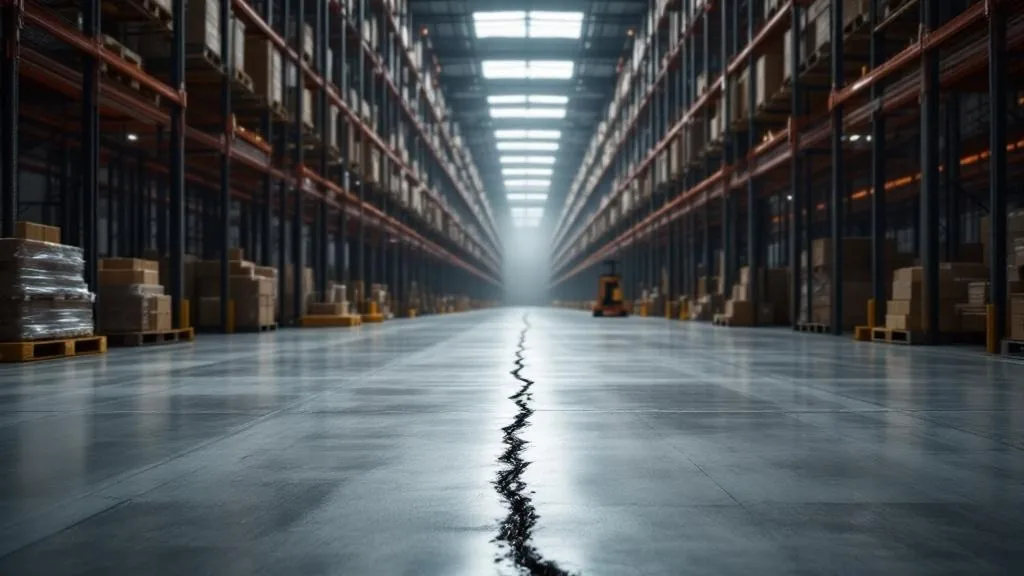
Warehouse and industrial floor failure is more than a flat-floor problem. It throws racking out of plumb, breaks dock plates, slows forklift cycle times, accelerates wheel and bearing wear, and in worst cases triggers safety incidents. We lift industrial floors back to spec without taking your operation offline.
What we see most
- Settlement at column bases or near isolation joints
- Slab cracks across forklift travel paths
- Drops at expansion joints between original slab and additions
- Voids near drains, wash bays, or process water lines
- Settled bays in older industrial buildings on minimally compacted fill
- Differential movement at pallet rack base plates causing rack lean
How industrial floor lifts work
- Map the floor — laser scanning, levels, sounding for voids
- Phase the project — bay-by-bay schedule that fits your shift pattern
- Drill injection points — penny-sized (5/8") holes laid out per the lift plan
- Inject foam — high-density polyurethane fills voids and lifts the slab
- Verify — laser scan post-lift to confirm levelness/flatness targets
- Patch and clean — surface restored, forklifts roll back over it the same shift
Why foam (not slurry, not replacement) for industrial
Industrial floors fail because the soil underneath them lost capacity. Adding more weight (mud slurry) under an already-failed soil profile is the wrong move. Polyurethane foam is light, waterproof, and dimensionally stable — it fills voids, compacts loose soil, and reaches 90% strength in 15 minutes. Forklifts can roll back over the floor the same shift.
Coordination we handle
- Certificates of insurance to property owner, GC, or facility teams
- Phased schedules around shift patterns and inventory cycles
- Laser scanning pre/post for FF/FL verification when specified
- Engineering coordination for warranty or compliance documentation
- Coordination with rack installers for lift around installed systems