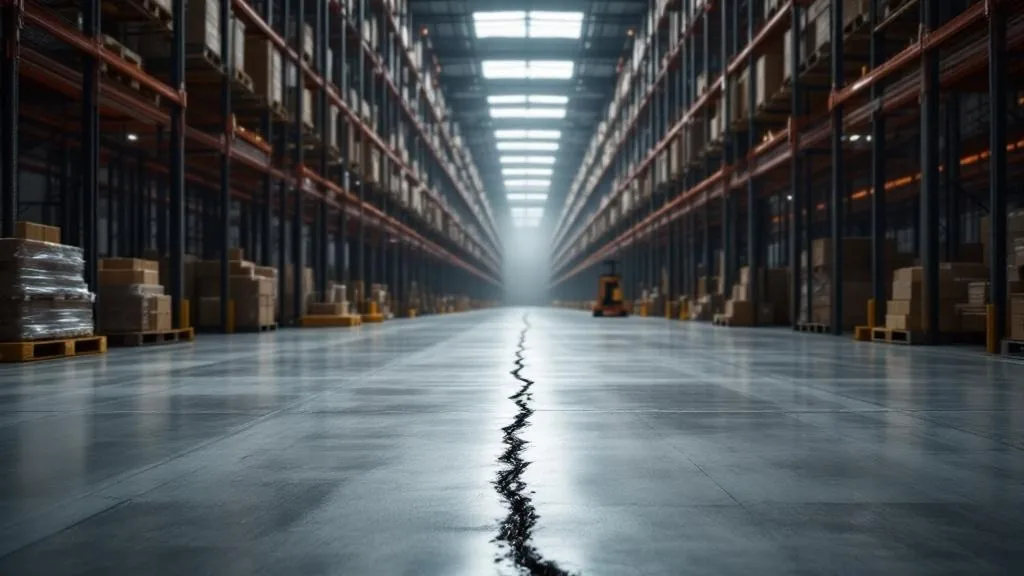
This is the umbrella page for our B2B and commercial work. A sunken warehouse floor stresses forklifts and pallet racking. A settled loading dock breaks dock plates. An offset sidewalk in front of a retail tenant is an open ADA claim. We solve all of it with the same technology departments of transportation use on highways — without shutting your operation down. Each niche application below is its own page with deeper scope, pricing, and case examples; this page is where to start if you do not yet know which scope applies.
Where commercial concrete fails
- Warehouse and industrial floors — settlement near racking, cracks across forklift paths, gaps at expansion joints
- Loading docks and ramps — settled approaches, mismatched dock plates, broken edges
- Parking lots and parking structures — drainage failures, slab heaves, settlement near drains
- Retail entrances and sidewalks — ADA trip hazards, slab offsets near doors, spalling at high-traffic areas
- Property management common areas — pool decks, walkways, courtyards, exterior tile and stamped surfaces
- HOA and multifamily — clubhouse decks, mail-kiosk pads, garage entrances
How we work commercial schedules
Most of our commercial work is phased and after-hours. Our equipment is mobile, the footprint is small (a single trailer with the foam pump and lift kit), and the injection points are penny-sized patches that can be touched up to match the rest of the floor. We can:
- Phase the lift across multiple bays so you keep operating
- Work overnight or on weekends
- Coordinate with general contractors, property managers, or facility teams
- Provide certificates of insurance and ROC documentation in advance
- Coordinate with engineering or testing requirements (e.g., laser scans pre/post)
Why foam, not mudjacking, for commercial
Mudjacking puts 100+ lb/cubic foot of slurry under a slab that already failed because the soil could not support what was on top. The added mass creates new failure paths. Polyurethane foam is 2–4 lb/cubic foot, dimensionally stable, waterproof, and reaches 90% strength in 15 minutes — so forklifts can roll back over the floor the same shift.