Mesa was registered as a one-square-mile townsite in 1878, up on the terrace the city is named for, and it grew east from there in rings. Drive Main Street or Southern Avenue from Country Club Drive out to Ellsworth Road and you pass the early bungalow blocks of the Evergreen and West Second Street districts, the postwar tracts of the 1950s and 1960s, the big subdivisions dropped onto retired citrus groves and alfalfa fields in the 1970s and 1980s, and finally the master-planned communities out by Gateway airport. Under the older west half is Salt River terrace sand and gravel with caliche close to the surface, plus a century of canal and flood irrigation. Under the newest east half is engineered fill on ground that was farmed, stripped and regraded inside the last twenty years. Those two halves crack and settle for different reasons, and they need different fixes. We cover all of Mesa.
What we fix in Mesa
- Foundation repair — differential settlement in the pre-1980s neighborhoods west of Gilbert Road, where footings and slabs went in over unimproved farm and terrace soil with very little subgrade work
- Stem wall repair — Mesa has a large stock of older slab-and-stem-wall homes on lots that were flood irrigated for decades, and that is the classic setup for rebar corrosion and spalling at grade level
- Foam injection leveling — our primary method across the city because most Mesa lots are tight, mature and heavily landscaped. Polyurethane lifts from penny-sized holes instead of open trenching
- Concrete crack repair — the west half of Mesa is full of flatwork fifty to seventy years old that has already finished moving. Once it is stable the cracks get sealed rather than torn out
- Concrete leveling — driveways, walks, patios and pool decks from the downtown historic districts through the Superstition Springs area and out to Eastmark, all with the same foam process
- HOA concrete repair — east Mesa holds one of the heaviest concentrations of 55-plus communities in the metro, and their common-area walkways are a standing maintenance line item rather than a one-time repair
Why concrete moves in Mesa
- Mesa sits on a terrace of Salt River alluvium, sand and gravel in a silty matrix, at roughly 1,326 feet. A hard caliche layer sits close to the surface across much of the city, and water that reaches it stops soaking downward and starts running sideways along the top of it
- Lehi, on the north side between the Consolidated Canal and the Salt River, sits on river-bottom ground rather than terrace. It was settled in 1877, a year before the Mesa townsite was registered, and the alluvium under it is finer and looser than anything up on the mesa proper
- The Consolidated Canal and the Eastern Canal both cut through the middle of the city, and the neighborhoods platted along them were laid out for flood irrigation. Lots still on an SRP delivery schedule take a flood roughly every two weeks through the summer, and that water sits against stem walls and slab edges every cycle
- Most of Mesa between Country Club Drive and Power Road was citrus grove, alfalfa or cotton before it was subdivided from the 1970s onward. Old furrow lines, buried irrigation laterals and disced topsoil leave compaction uneven from one side of a lot to the other
- Fine-grained clay shows up in Mesa as scattered lenses rather than one continuous layer, which is why two houses on the same block can behave completely differently through a single wet season
- Northeast Mesa is cut-and-fill grading in the rocky foothills below the Usery Mountains. Red Mountain Ranch went in around 1988, Las Sendas through the 1990s and Mountain Bridge from 2010 onward, and that corner is the one part of the city where hillside fill rather than farm ground drives the movement
- Southeast Mesa was graded from scratch inside the last fifteen years. Eastmark covers roughly 3,200 acres that General Motors ran as its Desert Proving Ground from 1953 until the site closed in 2009, so that dirt was stripped, compacted and reworked before a single house went up. Cadence, at Ray and Ellsworth, was built out between 2018 and 2024 on the same kind of engineered pad
- Nearly everything built in Mesa before the mid-1980s is conventional slab or slab-and-stem-wall, including the 55-plus communities that started going in during the 1950s. Most of what went up east of Power Road from the mid-1990s onward is post-tension, and a crack means something completely different on each
What typically fails in Mesa
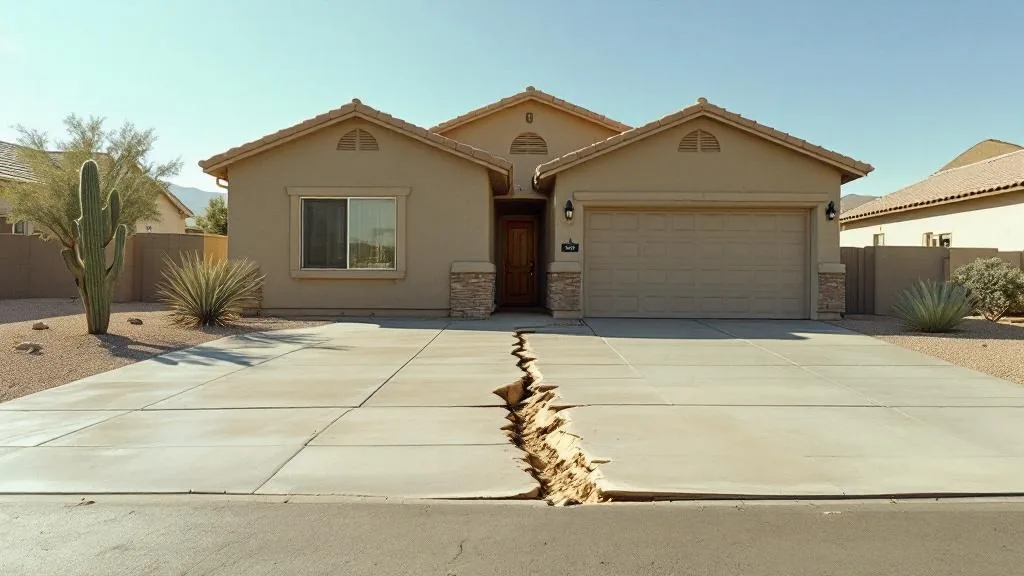
The defining Mesa problem sits in the 1970s and 1980s tract belt, roughly Dobson Ranch on the west across to Power Road on the east. The homeowner describes a driveway or back patio that has dropped an inch or two away from the house, usually with a crack that has been opening slowly for a couple of years. Almost every one of those lots was farm ground before it was a subdivision. Fill placed over old irrigation furrows and buried laterals was never compacted to anything like a modern spec, and forty years of flood irrigation, a leaking hose bib or a failing sewer lateral will soften a pocket of it. The slab bridges that pocket until it cannot. We start by working out where water has actually been going on the lot, because a lift over an unresolved leak buys a few years at best. Then we drill a small hole pattern, fill the void with polyurethane and bring the slab back to grade. The house itself usually needs nothing.
Common Mesa jobs
- Driveway leveling — the dominant Mesa job, almost always the approach slab dropping away from the garage over settled farm fill
- Sidewalk leveling — east Mesa has miles of narrow older walks and golf cart paths through its 55-plus communities, and decades of irrigation and root growth have left trip hazards along most of them
- Garage floor leveling — older west Mesa garages where the slab was poured thin over unengineered fill, then loaded for fifty years with vehicles, shelving and a softener or freezer in the corner
- Post-tension slab repair — Eastmark, Cadence, Mountain Bridge and effectively everything east of Power Road built since the mid-1990s. We scan with ground-penetrating radar before any hole gets drilled
- Warehouse floor leveling — the aerospace and industrial buildings around Falcon Field, the Elliot Road technology corridor and the parks near Gateway airport, where slab joints and dock aprons settle under repeated forklift and trailer loading
Neighborhoods we serve in Mesa
We cover Mesa and the surrounding Maricopa County communities, including:
- Downtown Mesa
- Evergreen Historic District
- West Second Street Historic District
- Lehi
- Dobson Ranch
- Alta Mesa
- Red Mountain Ranch
- Las Sendas
- Mountain Bridge
- Superstition Springs
- Augusta Ranch
- Eastmark
- Cadence at Gateway
- Dreamland Villa
Mesa ZIP codes served: 85201, 85202, 85203, 85204, 85205, 85206, 85207, 85212.
Nearby service areas
Working somewhere else in the Valley? We also cover Gilbert, Tempe and Chandler.