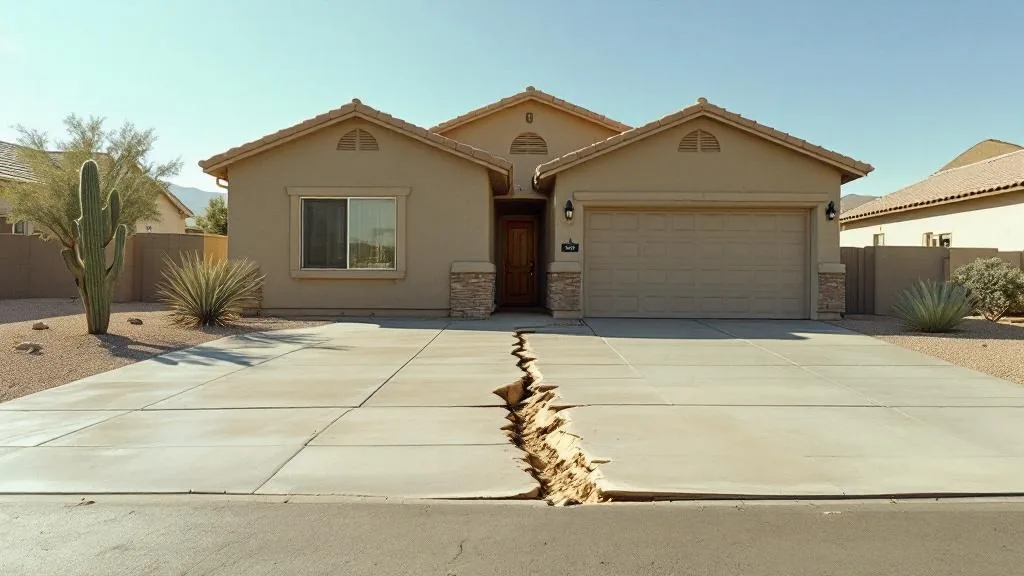
Scottsdale grew north instead of outward. The city runs about 31 miles from its southern edge to its northern one, and the ground under it changes completely along the way. That shape sorted the building eras into bands. South Scottsdale went up in the 1950s and 1960s as block tract housing on thin slabs poured over valley basin fill, on old farm ground the Arizona Canal used to irrigate. McCormick Ranch, Scottsdale Ranch and Gainey Ranch followed through the late 1970s and 1980s, platted around man-made lakes and golf turf. Grayhawk, McDowell Mountain Ranch, DC Ranch and everything above them came in the 1990s and later, on pads cut and filled into the granite pediment running off the McDowells. A 1958 slab and a 2004 slab six miles apart are two different problems with two different fixes. We service the entire Scottsdale area, and the first thing we do on site is work out which band your house sits in.
What we fix in Scottsdale
- Foundation repair — settlement in the postwar south Scottsdale tracts, where shallow footings were set on basin sand and silt that was never engineered fill to begin with
- Foam injection leveling — polyurethane fills the void and lifts the slab through penny-sized holes, which matters on finished Scottsdale properties where tearing out pavers, coping or mature landscape is the expensive part
- Stem wall repair — masonry stem walls on the 1960s through 1980s housing stock spall and delaminate once the rebar inside starts to corrode, and decades of turf irrigation along the footing speeds that up
- Post-tension slab repair — nearly everything built north of the Loop 101 is post-tension, so DC Ranch, Grayhawk, Silverleaf and Troon North get scanned with ground-penetrating radar before anyone drills
- Concrete crack repair — Old Town and the streets around it carry flatwork that is sixty and seventy years old and has been cracking and shifting the entire time
- Commercial concrete leveling — the Scottsdale Airpark is one of the largest employment centers in the Phoenix metro area, and its flex and warehouse buildings sit on slabs that take forklift and truck loading every day
Why concrete moves in Scottsdale
- Indian Bend Wash runs about 11 miles through the middle of the city. The greenbelt built along it starting in the 1970s is a flood-control channel first and a park second, and the homes flanking it sit on old floodplain ground
- The southern half of the city is basin fill: layered sand, silt and gravel that consolidates unevenly under load, because nobody was compacting subgrade to a modern spec when those 1950s slabs went down
- Scottsdale started as canal-irrigated farmland along the Arizona Canal, and the postwar tracts in the south were platted straight over those old fields and lateral ditches, which leaves worked-over, inconsistent ground under a lot of mid-century slabs
- McCormick Ranch, Scottsdale Ranch and Gainey Ranch were laid out around man-made lakes and golf turf, and forty-odd years of irrigation keeps the soil near those footings wetter than the surrounding desert ever gets
- Caliche sits close to the surface across much of central Scottsdale. Water will not percolate through a cemented caliche layer, so it travels sideways along the top of it and undercuts slab edges instead of draining away
- North of the Loop 101 the ground is granite pediment running off the McDowell Mountains and Pinnacle Peak. Those lots were cut into rock on the high side and filled on the low side, which routinely puts half a pad on bedrock and half on fill
- North Scottsdale lots carry real grade, so monsoon runoff moves fast and concentrates. A small grading error that would be harmless on a flat Old Town lot will point a season of storm water at one corner of a foundation up there
- Pools are close to universal here, in the mid-century neighborhoods and the master-planned ones alike, and a leaking shell, return line or deck drain will strip the fines out of the backfill under a deck for years before anyone notices water loss
What typically fails in Scottsdale
In Scottsdale the pool is where trouble surfaces more often than anywhere else on the property. The usual version is a home built between the late 1970s and the late 1980s, often in McCormick Ranch, Scottsdale Ranch or Gainey Ranch, where the deck has dropped away from the coping and left a lip along one side. Sometimes the cool-deck coating has cracked in a long line running parallel to the water. What is underneath is almost always a void. The deck was poured over backfill placed against the pool shell, that backfill was never compacted to the same standard as native ground, and decades of irrigation, deck drains and splash-out have washed the fines out of it. Foam injection suits this well, because we fill the void and lift the deck without pulling coping or tile. The part that matters more than the lift is finding where the water is coming from, since a leaking return line will hollow out the same spot again.
Common Scottsdale jobs
- Pool deck leveling — the highest-volume job we run in Scottsdale, concentrated in the 1970s and 1980s neighborhoods where the deck backfill has had forty years to wash out
- Driveway leveling — in north Scottsdale it is the fill side of a cut-and-fill lot settling away from the garage; in the south it is a sixty-year-old slab on unimproved ground
- Patio leveling — covered patios and built-in outdoor kitchens are heavy, and on a graded hillside lot a settled patio starts routing water back toward the house
- HOA concrete repair — Scottsdale is dense with governed communities, so we write itemized estimates a board can read, question and approve before we mobilize
- Pre-sale concrete repair — a lot of Scottsdale stock is second homes and rentals, and settled flatwork lands in the inspection report right when a deal is on a clock
Neighborhoods we serve in Scottsdale
We cover Scottsdale and the surrounding Maricopa County communities, including:
- Old Town Scottsdale
- South Scottsdale
- Shea Corridor
- McCormick Ranch
- Gainey Ranch
- Scottsdale Ranch
- Ancala
- McDowell Mountain Ranch
- Grayhawk
- DC Ranch
- Silverleaf
- Troon North
- Pinnacle Peak
- Desert Mountain
Scottsdale ZIP codes served: 85250, 85251, 85254, 85255, 85257, 85258, 85260, 85262.
Nearby service areas
Working somewhere else in the Valley? We also cover Phoenix, Fountain Hills and Cave Creek.