Chandler started as A.J. Chandler's irrigated ranch, and the Consolidated Canal his company dug to water it still runs through the city. Cotton, alfalfa and grain grew here under flood irrigation into the 1970s and 1980s, and then the fields went under subdivisions in a hurry. Chandler nearly doubled in population between 1990 and 2000, and the median home in the city was built in 1997. That history is the whole story for concrete here. The ground under most of Chandler is old farm ground: fine-textured basin-floor alluvium with clay-rich layers a foot or two down, wetted and dried on an irrigation schedule for decades, then scraped dead flat and capped with slab. Chandler also has no wash to carry storm runoff out of town. It goes into retention basins, greenbelts and drywells, which concentrates water at the same engineered points year after year. We service the entire Chandler area, and we start by finding where the water actually goes.
What we fix in Chandler
- Foundation repair — settlement in the original townsite and the pre-1980 streets around downtown, where slabs went down on unimproved field soil with almost no subgrade prep by modern standards
- Foam injection leveling — the workhorse method here. Chandler slabs sit on fine-grained farm-ground alluvium that loses volume rather than washing out, which is exactly the void condition polyurethane fills and lifts
- Post-tension slab repair — Chandler's median build year is 1997, so a large share of the housing stock is post-tension. Anything from that era gets scanned with ground-penetrating radar before we drill a hole
- Concrete leveling — pool decks, patios, walks and garage slabs across the south Chandler master plans, where the earliest phases are now twenty-five years old and the newest are hitting fifteen
- Concrete crack repair — the older streets around the San Marcos and the 1990-to-1994 subdivisions like Pecos Ranch have conventional slabs, where cracking is usually the first thing a homeowner notices
- HOA concrete repair — Chandler is dense with master-planned associations, and the common-area walks, mail kiosk pads and ramada slabs move on the same clay the houses do
Why concrete moves in Chandler
- Chandler sits on the flat relict basin floor of the Salt and Gila river system. The soils mapped across this part of the East Valley are fine-textured alluvium, and several of the common series carry a buried clay-rich argillic horizon a foot or two below the surface that swells and shrinks with moisture
- Nearly all of the city was flood-irrigated cropland into the 1970s and 1980s. Ponding water on the same ground for decades leaves a subgrade that behaves nothing like raw desert soil once it is scraped, graded and capped with concrete
- The city has no natural drainage channel to carry storm runoff away. Chandler infiltrates it on site instead, through retention basins, greenbelts, park turf and drywells. A groundwater recharge study of the city inventoried roughly four thousand drywells inside city limits, so runoff soaks in at fixed engineered points rather than spreading out
- Several SRP canals cross Chandler, including the Consolidated, the Eastern, the Highline and the Kyrene Branch. The Consolidated was dug by A.J. Chandler's own canal company to water this ground, and neighborhoods built over the old field system can still have abandoned laterals and turnouts buried under yards, driveways and side walks
- Chandler's median home was built in 1997, and a very large share of the housing stock went up between 1995 and 2009. That is a huge volume of tract construction on rapidly graded pads, all reaching the twenty-to-thirty-year mark at the same time
- South Chandler is built around engineered water. Ocotillo was conceived in 1986 as a 1,900-acre plan with roughly 160 acres of interconnected man-made lakes, and Fulton Ranch, Layton Lakes and Andersen Springs each have their own water features. Subgrade near those lakes and the turf around them stays wetter than the desert soil a mile away
- The whole city sits near 1,200 feet with only a few tens of feet of relief across miles of ground. A settled patio or walk in Chandler has almost no slope to work with, so a small drop reverses drainage in a way it would not on a sloped north-Valley lot
- The Arizona Geological Survey maps an earth-fissure study area at Chandler Heights, southeast of the city toward the Santan Mountains, where groundwater withdrawal drove basin subsidence. Most of Chandler proper is outside it, but it is a reminder that this basin has a long pumping history
What typically fails in Chandler
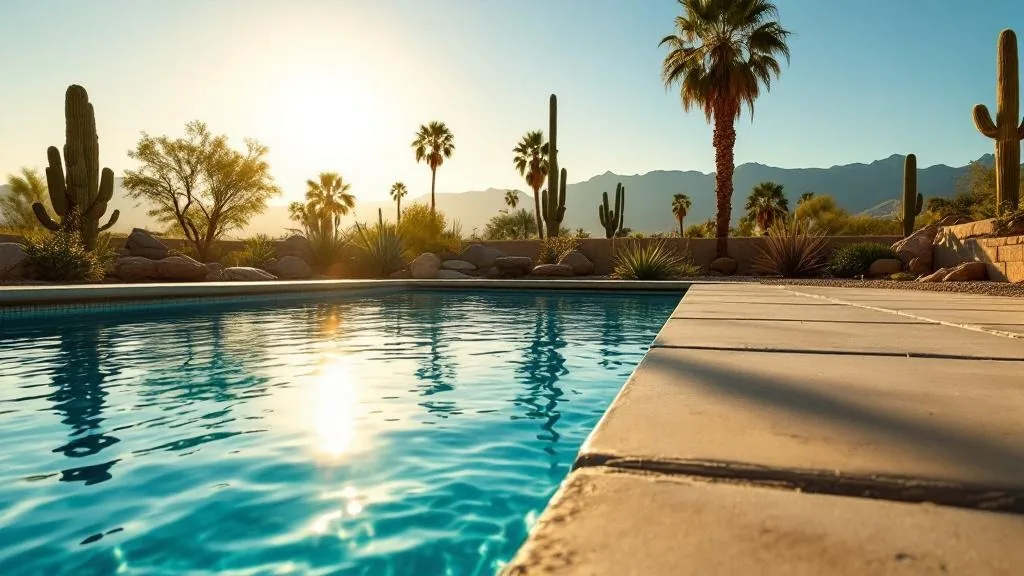
The classic Chandler failure is a pool deck that has dropped away from the coping. It repeats in Ocotillo, Fulton Ranch, Clemente Ranch and Cooper Commons, where the pools run fifteen to thirty years old and the decks were poured on graded farm ground. The sequence is almost always the same. The deck settles a fraction of an inch, then more. Water starts running toward the pool instead of away from it. The joint at the coping opens up, and the homeowner assumes the shell is failing. Usually it is not. Usually the subgrade under the deck has lost volume, either from clay shrinking through a long dry stretch or from irrigation, filter backwash and deck-drain water finding a path underneath. We probe for the void first and look at where the deck drains and downspouts actually discharge, because on ground this flat there is almost no margin in the slope. Then we foam-inject, lift the deck back to grade, close the joint and re-seal it. A lift costs a fraction of tear-out and keeps the original finish.
Common Chandler jobs
- Pool deck leveling — the highest-volume job in the city. South Chandler is dense with fifteen-to-thirty-year-old pools, and the deck settles away from the coping before anything else moves
- Patio leveling — on ground this flat a settled patio stops shedding water and starts holding it against the back of the house instead
- Sidewalk leveling — greenbelt paths and mail kiosk pads in the master-planned communities, where irrigated turf keeps the subgrade cycling wet and dry all year
- Garage floor leveling — common on the 1990s and 2000s tract homes, where the garage slab was poured over backfill beside the footing and later dropped away from the house
- Commercial concrete leveling — the Price Road corridor runs office and manufacturing campuses over the same basin-floor soils as the neighborhoods, with accessible routes and parking-lot walks that have to stay flush
- Warehouse floor leveling — the Chandler Airpark area keeps adding distribution and semiconductor-supply buildings, and slab joints and racking bases there take constant load
Neighborhoods we serve in Chandler
We cover Chandler and the surrounding Maricopa County communities, including:
- Downtown Chandler
- Ocotillo
- Ocotillo Lakes
- Fulton Ranch
- Layton Lakes
- Clemente Ranch
- Circle G Ranches
- Sun Groves
- Cooper Commons
- Andersen Springs
- Markwood North
- Pecos Ranch
- Springfield
- Solera
Chandler ZIP codes served: 85224, 85225, 85226, 85248, 85249, 85286.
Nearby service areas
Working somewhere else in the Valley? We also cover Gilbert, Tempe and Mesa.