Glendale started as a farm town. William J. Murphy finished the Arizona Canal in 1885, laid Grand Avenue out on the diagonal, and sold the land south of the canal on the strength of the water that came with it. For the next seventy years this ground grew cotton, sugar beets and citrus, all of it flood-irrigated. The subdivisions that cover it now sit on dirt that was plowed, leveled and soaked for decades before anybody poured a slab on it. Underneath that is Salt River Valley basin fill: alluvium laid down in layers of silt, fine sand and clay of differing density rather than one uniform bed. Water does not sink straight down through stratified soil. It travels sideways along the loosest seam. Put a postwar tract boom, a 1980s buildout over the Arrowhead citrus groves and yards that still take flood irrigation on top of that, and the pattern holds: in Glendale, concrete problems start as water problems.
What we fix in Glendale
- Foundation repair — movement in the 1950s and 1960s tract homes through central Glendale, where thin slabs went down on plowed field soil with almost no subgrade work
- Foam injection leveling — the method that does most of the work here, because the typical Glendale failure is a void water carved out under a slab rather than a structural failure of the slab itself
- Stem wall repair — Glendale has a deep stock of block homes on stem walls from the 1950s through the 1970s, and an irrigated or badly graded yard keeps the base of that wall damp year after year
- Concrete crack repair — most Glendale housing predates post-tension construction, so a crack in a conventional slab reads differently here than it does in a late-1990s West Valley subdivision
- Commercial concrete leveling — the Westgate and stadium district plus the retail strips along Glendale, Bell and 59th, where the work has to fit around event calendars and tenant hours
- Concrete leveling — driveways, patios and pool decks across Arrowhead and the north-end subdivisions, which are now well past thirty years on the ground
Why concrete moves in Glendale
- Glendale sits on Salt River Valley basin fill: stratified silt, fine sand and clay rather than a single uniform bed. Water follows the loosest layer sideways, which is how a leak twenty feet away ends up under a slab
- The Arizona Canal, finished in 1885, cuts diagonally across the city, and its laterals and field turnouts watered this ground for generations. Many were abandoned in place when the farms were subdivided, and abandoned in place is not the same as capped and backfilled
- This was flood-irrigated cropland at real scale. A beet sugar factory ran here in the early 1900s and cotton and citrus followed. Subdivisions went in over a deep plow layer and old field grading that were never engineered to carry a house
- Flood irrigation is still delivered to residential lots in parts of Glendale, mostly the older acre-lot properties in the north-central part of town. Those yards take several deep saturation cycles a year right against the foundation
- Caliche sits close to the surface across much of the city. Once a pool excavation or a utility trench breaks that hard cap, the trench itself becomes the drainage path and routes water under whatever slab it runs past
- The New River and Agua Fria channels run south along the western edge of Glendale, and Adobe Dam sits at the north end off 43rd Avenue. Property along those corridors takes concentrated monsoon flow the rest of the city never sees
- Arrowhead was built out over former citrus grove ground starting in the 1980s. That soil was tilled deep, amended and irrigated for decades, then regraded and filled to make lots, and the flatwork on it is still consolidating
- The city is close to table-flat at about 1,150 feet, with real relief only at the Hedgpeth Hills in Thunderbird Conservation Park. Flat lots do not shed monsoon water, they pond it, and it sits against slab edges until it soaks in
What typically fails in Glendale
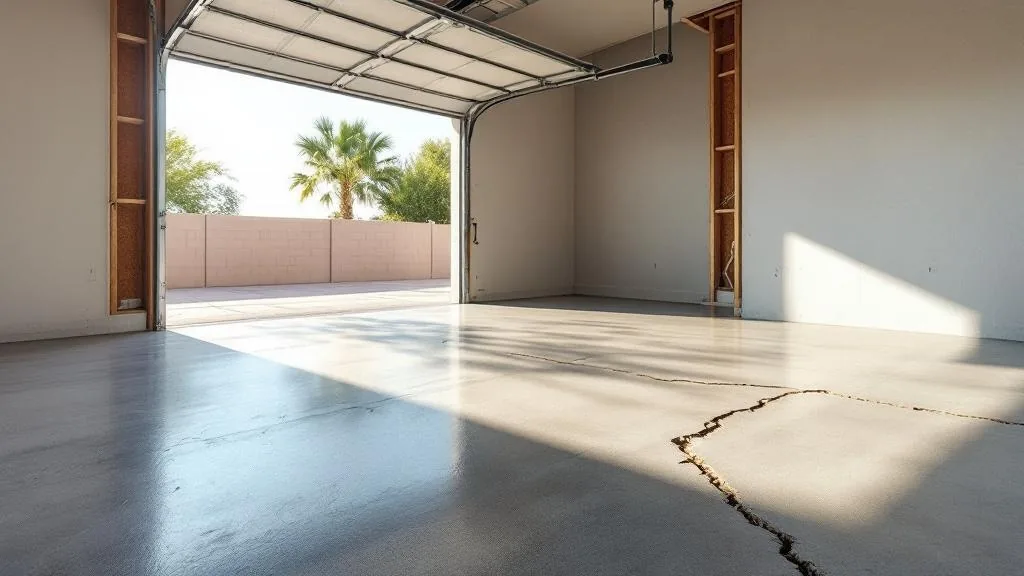
In Glendale the problem usually starts at the garage. A homeowner in a central or north Glendale house, usually built somewhere between the late 1970s and the mid-1990s, notices the garage floor has dropped near the overhead door, or that the driveway has pulled down away from the slab edge. There is a lip, sometimes a crack running back toward the wall. The first thing we do is hunt for the water, because in Glendale there is almost always a source. It might be an irrigated yard, a downspout dumping at the corner, an old lateral nobody abandoned properly, or a pool trench that broke through caliche and now drains under the apron. The lift itself is routine. We drill 5/8-inch access holes, inject polyurethane to fill the void and bring the slab back to grade, and you can drive on it the same day. What decides whether it stays fixed is what happens to the water afterward.
Common Glendale jobs
- Driveway leveling — the highest-volume job in the city, almost always the drop where the driveway meets the garage slab
- Pool deck leveling — pool density runs high through Arrowhead Ranch and Arrowhead Lakes, and a deck settling toward the coping usually means trench backfill is washing out
- Garage floor leveling — attached garages on the postwar and 1980s tract stock, where the garage slab was poured thinner than the house and moves first
- Sidewalk leveling — the mature shade trees on the older irrigated blocks around Old Towne and Catlin Court put roots under front walks and lift them into trip hazards
- Warehouse floor leveling — distribution and light industrial buildings out toward the Loop 101 and 99th Avenue, where slab joints drop under repeated forklift traffic
- HOA concrete repair — the Arrowhead associations carry long runs of common-area walk, ramada pad and pool deck that were all poured in the same few years and age on the same schedule
Neighborhoods we serve in Glendale
We cover Glendale and the surrounding Maricopa County communities, including:
- Catlin Court
- Historic Downtown Glendale
- Arrowhead Ranch
- Arrowhead Lakes
- The Highlands at Arrowhead Ranch
- Hillcrest Ranch
- Marshall Ranch
- Rovey Farm Estates
- Sunburst Farms
- Missouri Ranch
- Sahuaro Ranch
- Manistee Ranch
- Thunderbird Estates
- West Plaza
Glendale ZIP codes served: 85301, 85302, 85303, 85304, 85305, 85306, 85308, 85310.
Nearby service areas
Working somewhere else in the Valley? We also cover Peoria, Phoenix and Surprise.