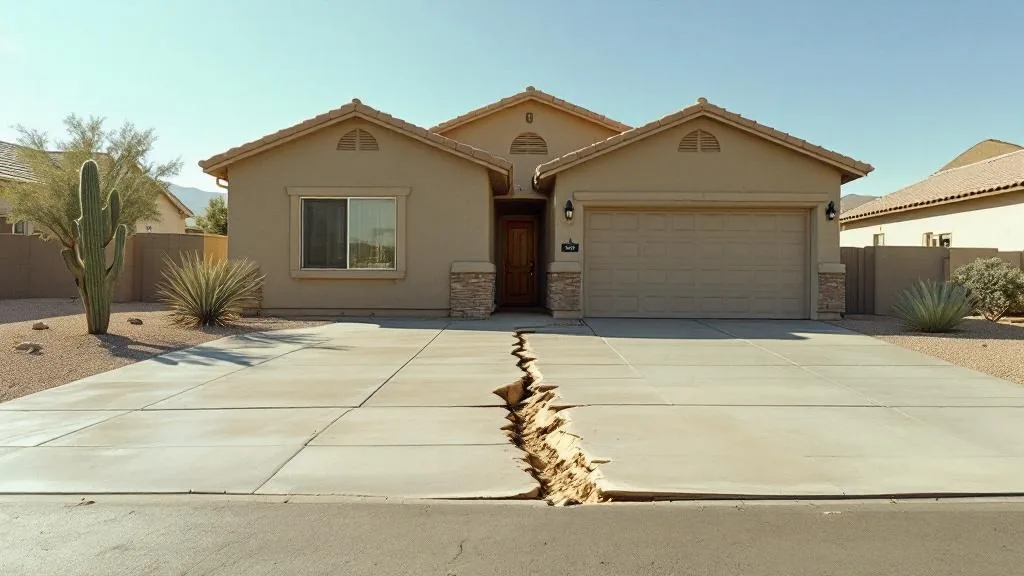
Peoria is really two cities stacked on top of each other. South of Bell Road you have Old Town and the postwar neighborhoods off Grand Avenue — homes from the 1950s through the 1970s, sitting on thin slabs poured over Agua Fria river-bottom soils with very little subgrade prep by modern standards. North of the Loop 303 you have Vistancia, Trilogy, Westwing Mountain and Sonoran Mountain Ranch: post-2000 master-planned communities carved into rolling desert terrain, where whole pads were built up out of engineered fill to make a hillside buildable. Those two halves fail in completely different ways, on completely different timelines, and they need different fixes. We service the entire Peoria area and diagnose which pattern you're actually dealing with before we quote anything.
What we fix in Peoria
- Foundation repair — settlement and stem-wall movement in the older Old Town and Grand Avenue corridor homes, where slabs were poured directly on unimproved river-bottom soil
- Foam injection leveling — the method that does most of the work up north — engineered fill compacts under load, leaving voids that polyurethane fills and lifts without excavation
- Post-tension slab repair — effectively every Peoria home built after the mid-1990s is post-tension, so anything north of the 101 gets GPR-scanned before we drill a single hole
- Concrete leveling — driveways, pool decks and patios — the highest-volume work in the northern subdivisions once they hit the 10-to-15-year mark
- Concrete repair — crack repair and void filling on the older central Peoria flatwork that has already moved and settled into place
Why concrete moves in Peoria
- The Agua Fria River corridor runs the length of western Peoria, and the alluvial sand and silt it left behind compacts unevenly under load — this is the dominant issue in the older southern half of the city
- Caliche hardpan sits close to the surface across most of central Peoria, so water that cannot percolate down runs sideways along the caliche layer and undermines slab edges instead
- Peoria climbs roughly 900 feet from Grand Avenue to the far north end — far more grade change than the flat East Valley cities, which makes drainage and lot grading the single biggest predictor of trouble here
- Vistancia, Trilogy, Blackstone and Westwing Mountain were built on cut-and-fill pads. Fill settles for 10 to 20 years, and settlement shows up first at the outer edge of the pad — driveways and side patios go before the house does
- Skunk Creek and New River wash channels concentrate monsoon runoff into narrow corridors, so homes backing those washes see repeated saturation cycles that flatter neighborhoods never get
- Post-1995 construction is almost universally post-tension slab, which means a crack has a completely different meaning here than it does on a 1965 conventional slab
- Pool density is very high in the northern master-planned communities, and a leaking pool shell or deck drain will wash out the subgrade beneath a deck long before anyone notices water loss
- Older central Peoria homes frequently have original 1960s sewer and irrigation lines whose slow leaks soften a small area of subgrade for years before the slab reacts
What typically fails in Peoria
The signature north-Peoria failure shows up 12 to 18 years into a Vistancia or Westwing Mountain house, as a driveway dropping away from the garage slab. There is usually a lip you can catch a toe on, sometimes a hairline crack running diagonally from a corner of the garage opening. The house itself is fine. What has happened is that the engineered fill beneath the flatwork — which was never under the same compaction spec as the pad under the house — has consolidated, leaving a void. Foam injection is a good fit for exactly this: we drill a pattern of penny-sized holes, fill the void, lift the slab back to grade, and you can park on it the same afternoon. The part homeowners are often surprised by is that we spend the first part of the visit looking at where roof and lot drainage actually goes, because on Peoria's slopes a lift that does not fix the water source will simply happen again in five years.
Common Peoria jobs
- Driveway leveling — the single most common job in north Peoria — the garage-to-driveway lip that appears once fill settles
- Pool deck leveling — very high pool density in Vistancia and Trilogy, and decks pull away from the coping as the surrounding fill drops
- Patio leveling — sloped lots mean a settled patio often ends up draining toward the house rather than away from it
- RV pad leveling — north Peoria has a lot of RV-friendly lots near Lake Pleasant, and a loaded rig on a fill pad concentrates weight fast
- Sidewalk leveling — front walks and side-gate paths in the older central neighborhoods where the ground has been moving for fifty years
Neighborhoods we serve in Peoria
We cover Peoria and the surrounding Maricopa County communities, including:
- Old Town Peoria
- Vistancia
- Trilogy at Vistancia
- Blackstone
- Westwing Mountain
- Sonoran Mountain Ranch
- Fletcher Heights
- Terramar
- Sierra Verde
- Crossriver
- Camino a Lago
- Lake Pleasant Heights
- Ironwood
- Country Meadows
Peoria ZIP codes served: 85345, 85373, 85381, 85382, 85383, 85385.
Nearby service areas
Working somewhere else in the Valley? We also cover Glendale, Surprise and Phoenix.