A void under a slab is exactly what it sounds like — air space where soil used to be. Once a void exists, the slab above it has nothing to rest on at that point, and gravity does the rest: the slab flexes, then cracks, then settles. Filling the void early stops the cascade.
Where voids form
- Under driveways and garage floors near downspouts or irrigation
- Under pool decks where backwash lines or pool overflow soak the soil
- Under slabs above broken plumbing or sewer lines
- Under warehouse and commercial floors near drains or wash bays
- Under slabs poured on minimally compacted fill that consolidates over time
- After tunnels from rodents, monsoon flood paths, or buried tree-root decay
How we find voids
Most voids do not announce themselves with an obvious sinkhole — they show up as cracks, water stains, and slabs that "give" slightly when stepped on near a corner. Our diagnostic process:
- Visual — cracks, slope, water staining, vegetation patterns above the slab
- Sounding — calibrated tapping; hollow returns indicate a void below
- Test bore — when scope justifies it, a single small bore confirms void depth
How we fill voids
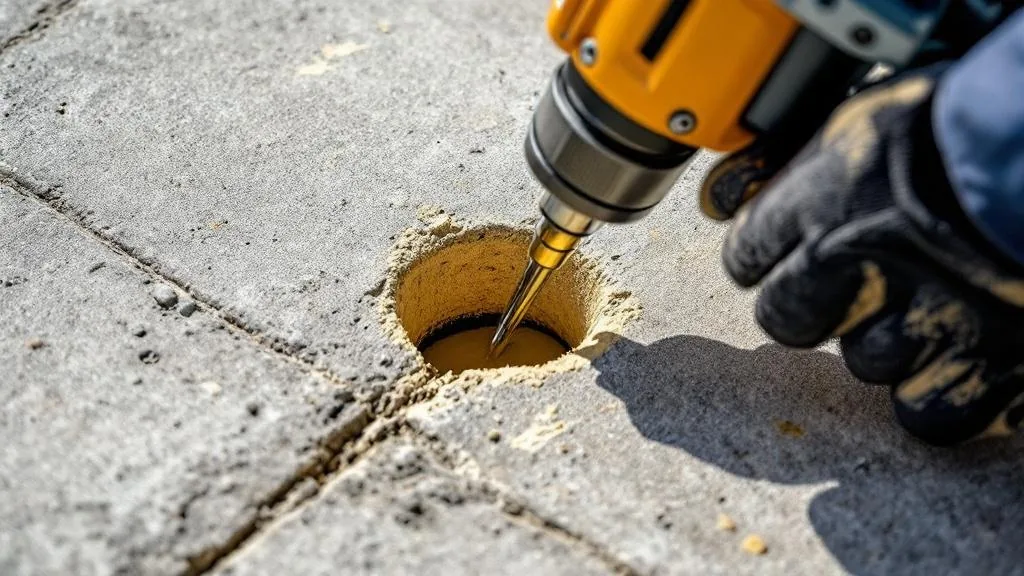
- Drill penny-sized (5/8") injection points through the slab into the void
- Inject high-density polyurethane foam — it expands ~20× and fills the void completely
- Foam compacts loose remaining soil at the void edges as it expands
- Foam reaches 90% strength in 15 minutes — slab is supported immediately
- Patch the holes flush with the slab surface
Why polyurethane foam is the right tool
The material that fills the void has to do four things at once: expand to fill irregular shapes, compact loose soil at the edges, resist water that may continue to track through the area, and stay dimensionally stable for decades. High-density polyurethane foam does all four better than any alternative — including concrete slurry (which adds weight to the very area that already failed) or sand fill (which can wash out again).
Cost
Most residential void-filling jobs run $600–$2,000 depending on void size and number of injection points. Commercial void filling is quoted by foam volume — typical warehouse void corrections run $1,500–$8,000+ depending on scale.