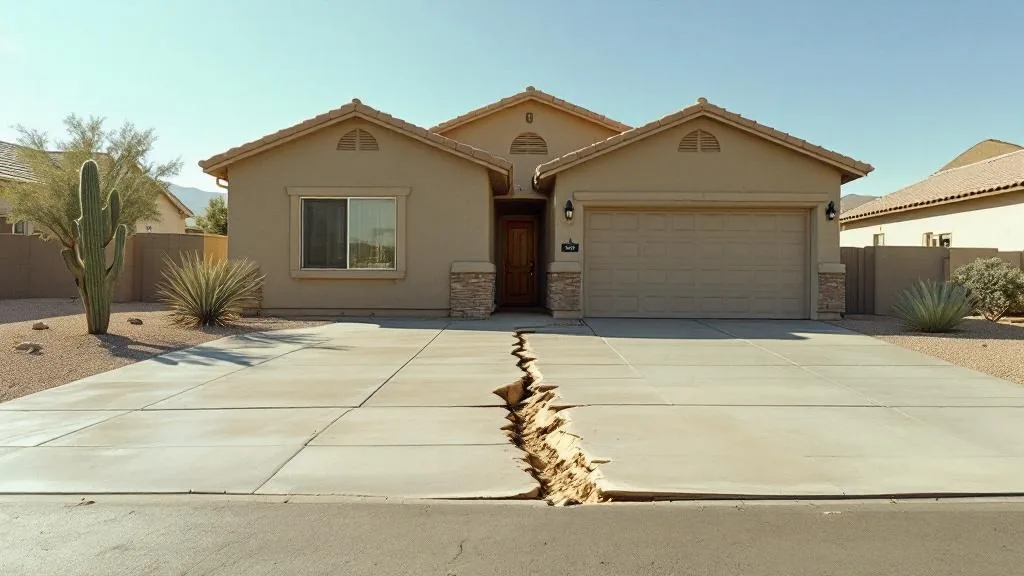
Land sales in Carefree opened in 1955 and homebuilding started in 1958, on lots laid out to work around the granite outcrops instead of blading them off. That decision still governs foundation work here. A Carefree lot is rarely uniform. You get shallow soil over decomposed granite, exposed bedrock in one corner, and loose slope-wash material piled at the base of an outcrop in another. When a building pad gets benched into competent rock and then built back up with engineered fill, part of the structure ends up bearing on something that will never move and part on material that will. The concrete poured across that seam is what cracks and drops first. Add Black Mountain rising a thousand feet above town and concentrating monsoon runoff onto a handful of lots, and you have the local pattern. We work the entire Carefree area, from the Town Center out to the far foothills.
What we fix in Carefree
- Foam injection leveling — the method that fits Carefree lots best, because it needs a hose and a hole pattern rather than an excavator that cannot physically get between the boulders and the retaining walls
- Stem wall repair — the original Carefree custom homes are masonry on stem walls, and on a graded hillside the uphill side of the stem wall spends decades with soil and runoff piled against it
- Foundation repair — settlement on the fill-supported portion of a benched pad, which is the failure mode that actually matters here rather than the whole-house sinking people expect
- Concrete crack repair — cracks that open along the rock-to-fill seam in motor courts, entry courts and terraces, where two halves of the same pour are supported by two different materials
- Post-tension slab repair — Carefree has no single build era, so a subdivision like Carefree Sentinel Rock Estates holds 1980s conventional slabs and 2010s post-tension slabs in the same tract, and every one gets scanned before we drill
- Concrete leveling — terraces, pool decks and driveway approaches, which on these grades are also the drainage plan whether the builder intended that or not
Why concrete moves in Carefree
- Carefree sits on a granite pediment at roughly 2,400 feet, and Black Mountain rises to 3,398 feet right at the town line. That is more than a thousand feet of relief inside a town of under nine square miles
- The exposed rock is coarse Precambrian granite that weathers spheroidally, which is why the Carefree boulders are rounded. It also breaks down into grus, the pea-to-pebble decomposed granite that drains fast but migrates faster
- Grus and slope-wash material collect at the base of outcrops and along the downhill side of lots. It looks like solid ground, it compacts poorly, and it behaves like loose fill once a slab edge bears on it
- Nearly every buildable pad here was benched into rock and rebuilt with engineered fill in compacted lifts, so mixed bearing, part bedrock and part fill, is the normal condition rather than the exception
- Much of Carefree drains through natural desert washes and lot grading rather than a curb-and-gutter storm system, so monsoon flow goes wherever the grading and the hardscape send it
- The elevation buys Carefree noticeably more annual rain than central Phoenix, and most of it arrives in a handful of monsoon cells. Total volume is not what moves soil here. Concentration is
- Build years run from 1958 to current construction and they are interleaved rather than zoned. Carefree Sentinel Rock Estates alone was built out between 1986 and 2018, so slab type has to be verified house by house
- Retaining walls are everywhere in Carefree because the stepped terraces demand them, and a wall with plugged weep holes turns into a dam that saturates the fill behind it every monsoon season
What typically fails in Carefree
The characteristic Carefree failure is a hillside lot where the flatwork on the downhill side drops while the uphill side does not move at all. Usually it is the motor court or the driveway approach. Sometimes it is a rear terrace off a great room. Homeowners describe it as one corner sinking. What is actually happening is that the slab spans two different bearing conditions. The uphill end sits on native rock or a benched cut that will never move, and the downhill end sits on engineered fill or slope-wash that is still consolidating. The crack opens at the seam because that is where the two halves want to go in different directions. Foam injection suits this well. We drill a hole pattern weighted toward the low side, fill the void, and bring the slab back in controlled lifts while we watch it move. Before any of that we trace where roof and hillside runoff actually lands, because on these grades water is usually the reason the fill went anywhere.
Common Carefree jobs
- Patio and terrace leveling — the downhill edge of a stepped terrace is the first thing to drop on a Carefree lot, and it usually starts draining back toward the house when it does
- Void filling — grus washes out from under a slab edge without leaving much surface evidence, so we often find a void well before the concrete has visibly settled
- Pool deck leveling — hillside pools here are usually built out on the fill side of the pad, and the deck pulls away from the coping as that fill compacts
- Driveway leveling — Carefree driveways are long, steep and often the only vehicle access, so a settled section becomes a scrape point rather than a cosmetic issue
- Garage floor leveling — detached and side-entry garages on these lots are frequently the piece sitting furthest out on fill, away from the benched portion of the pad
Neighborhoods we serve in Carefree
We cover Carefree and the surrounding Maricopa County communities, including:
- Carefree Town Center
- The Boulders
- Carefree Sentinel Rock Estates
- Carefree Foothills
- Black Mountain Foothills
- Carefree Grand View Estates
- Cow Track Estates
- Crossings at Carefree
- Ranchitos del Ray
- Velvet Shadows
- Carefree Fore
- Carefree Highlands
- Sky Ranch at Carefree
Carefree ZIP codes served: 85377, 85266, 85262, 85331.
Nearby service areas
Working somewhere else in the Valley? We also cover Cave Creek, Scottsdale and Phoenix.