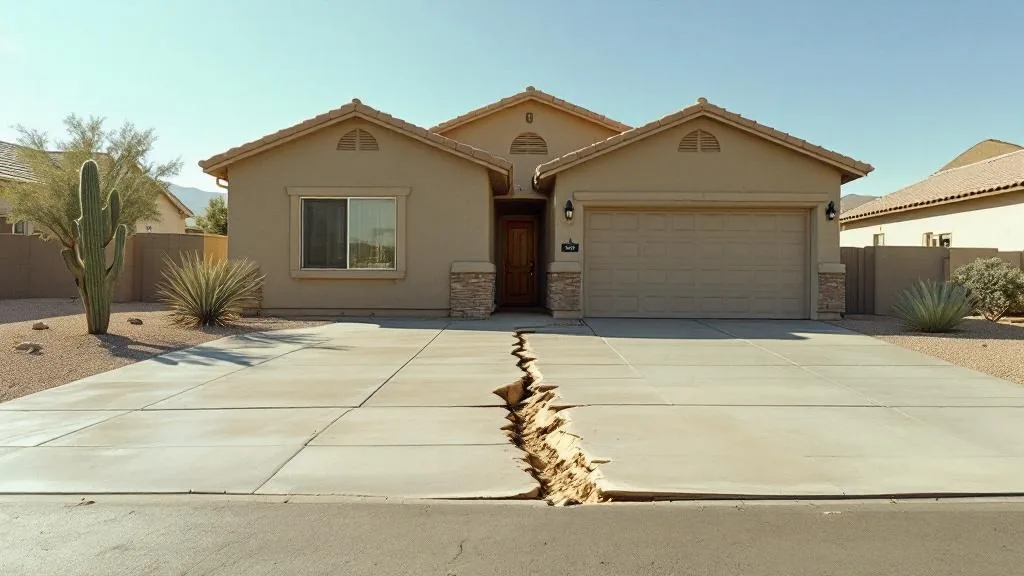
Queen Creek was farm ground until very recently. Cotton, alfalfa, pecans and olives came off this land for most of the last century, and the Roosevelt Water Conservation District has been delivering irrigation water to this corner of the valley since the 1920s. The town counted roughly 4,300 residents in the 2000 census and just under 60,000 by 2020. San Tan Valley, across the Pinal County line, went from open desert and scattered farm parcels to about 100,000 people over the same stretch. Almost every house out here sits on ground that was leveled, ditched, disced and flood-irrigated for decades before a builder ever touched it, and that history is the reason we get the calls we get. We work all of Queen Creek and San Tan Valley on both sides of the county line. The first thing we sort out on site is whether you have a soil problem, a water problem, or a farm-era artifact buried under your slab.
What we fix in Queen Creek & San Tan Valley
- Foam injection leveling — the right tool for old farm ground, because polyurethane fills the loose plow zone and abandoned ditch backfill without trenching up a finished yard
- Post-tension slab repair — the housing stock here is almost entirely post-2000 production, so we treat every slab as post-tension and scan it with ground-penetrating radar before a bit touches concrete
- Concrete leveling — driveways, pool decks and patios across the mid-2000s subdivisions that are all crossing the settlement window at roughly the same time
- Foundation repair — perimeter and stem-wall movement where a clay pocket under a slab has been cycling wet and dry against a shallow footing since the house was built
- HOA concrete repair — this is master-planned country. Encanterra, Johnson Ranch, Circle Cross Ranch and Skyline Ranch all carry miles of association-owned walkway, ramada pad and mail kiosk concrete
- Concrete crack repair — seasonal cracking that opens through the dry spring and closes again after the monsoon, which is the signature of the clay pockets scattered through this basin
Why concrete moves in Queen Creek & San Tan Valley
- Most of the developed land in both communities was irrigated farmland. Under a large share of these lots there is a disturbed plow zone, a compacted farm road, or the backfilled trench of an old irrigation lateral, and none of that shows on a plot plan
- Decades of flood irrigation reworked and wetted the upper soil profile in ways that stop holding true once the water is shut off, which is why a single driveway out here can settle hard on one side and hold on the other
- Expansive clay shows up in pockets across the Queen Creek basin. It takes on water during the July-to-September monsoon and gives it back through the dry spring, so movement here is seasonal and repeating rather than one-directional
- Caliche hardpan sits close to the surface across much of the area. Water that cannot pass down through caliche runs sideways along the top of it and undercuts slab edges instead of draining away
- The Arizona Geological Survey maps earth fissures in the Chandler Heights study area, which covers ground on both sides of the Maricopa and Pinal county line near east Queen Creek and north San Tan Valley. Fissures come from long-term groundwater withdrawal and basin subsidence, not from ordinary slab settlement
- Queen Creek Wash and Sonoqui Wash run northwest through town toward the East Maricopa Floodway. They are dry most of the year and carry serious water for a few hours at a time, so lots backing them take saturation cycles nobody three streets over ever sees
- Whole subdivisions here went up inside two or three year windows during the build-out boom, which means whole subdivisions reach the same settlement window together. When one driveway on a street drops, we usually hear from neighbors the same season
- The San Tan Mountains form the south edge of the area, and the alluvial fan material shed off that range is coarser and looser than the finer basin fill farther north, so the subgrade genuinely changes as you move south through San Tan Valley
What typically fails in Queen Creek and San Tan Valley
The pattern out here belongs to the mid-2000s subdivisions: a lip where the driveway meets the garage slab, usually with a crack running back from it toward the street. The house is fine. The driveway is not. What separates this area from the rest of the East Valley is the triage. Before we quote a lift, we want to know whether the void under that slab came from ordinary fill consolidation, from a clay pocket that has been swelling and shrinking with the monsoon since the house was built, or from something the farm left behind. Old irrigation laterals, buried ditch backfill and graded farm roads do not appear on any plan you were handed at closing, and they settle differently than the native ground beside them. The repair looks the same either way: a grid of penny-sized holes, polyurethane into the void, slab back to grade, drive on it that afternoon. The diagnosis is what determines whether it stays fixed.
Common Queen Creek & San Tan Valley jobs
- Driveway leveling — the highest-volume job in both communities, and on the long approach drives common on these lots the drop is usually at the apron rather than out at the street
- Pool deck leveling — backyard pools are close to standard in Queen Creek, and a deck that has pulled down off the coping is nearly always a subgrade washout rather than a coping failure
- Concrete void filling — filling the cavity left by an abandoned farm irrigation line or a monsoon washout before it grows large enough to take the slab with it
- Sidewalk leveling — association-owned walks in the big San Tan Valley master plans, where one settled panel becomes a trip hazard the board has to answer for
- RV pad leveling — RV gates are common on the larger lots here, and a loaded rig parked on soft farm-era backfill punches a pad down fast
- Garage floor leveling — three-car garages on these newer builds cover a lot of subgrade, and the settlement usually shows up first along the back wall where nobody looks
Neighborhoods we serve in Queen Creek & San Tan Valley
We cover Queen Creek & San Tan Valley and the surrounding Maricopa and Pinal County communities, including:
- Cortina
- Hastings Farms
- Charleston Estates
- Sossaman Estates
- The Pecans
- Whitewing at Whisper Ranch
- Ironwood Crossing
- Encanterra
- Johnson Ranch
- Circle Cross Ranch
- Copper Basin
- Skyline Ranch
- San Tan Heights
- Morning Sun Farms
Queen Creek & San Tan Valley ZIP codes served: 85140, 85142, 85143.
Nearby service areas
Working somewhere else in the Valley? We also cover Gilbert, Chandler and Mesa.