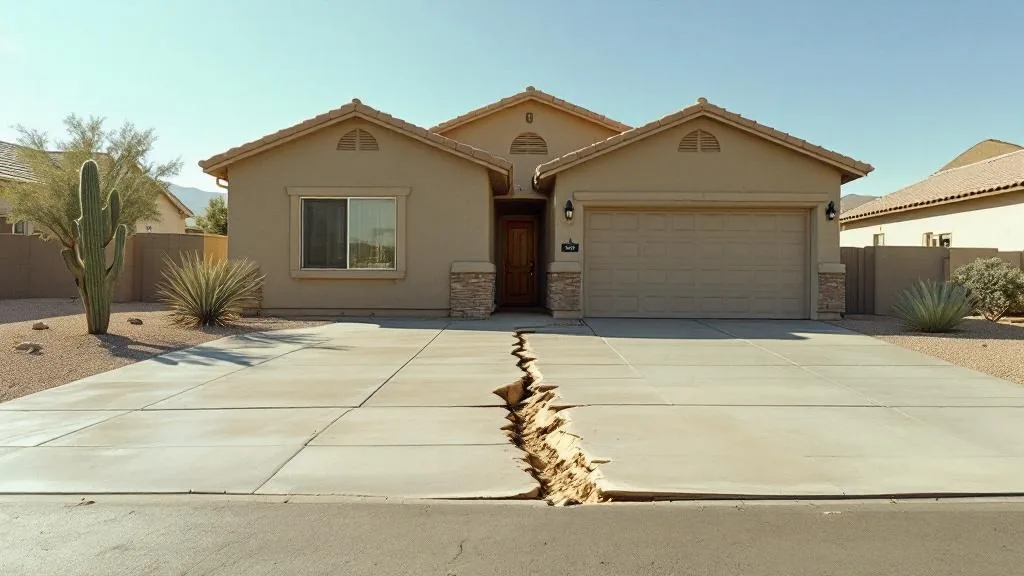
Phoenix concrete sinks for a few reasons that all stack on top of each other. None of them are mysterious — and once you know what is happening underneath your slab, the right fix is obvious.
1. Expansive clay soils
A huge portion of the Phoenix metro sits on expansive clay — soil that swells when it absorbs water and shrinks when it dries out. The Valley climate puts that clay through extreme cycles every year: 100°+ summers dry it out, monsoons soak it, and irrigation keeps cycling moisture through it. Each swell-and-shrink cycle leaves voids and consolidates soil unevenly.
Slabs and foundations sitting on expansive clay are along for the ride. Over enough cycles, voids open up beneath them, and the slab settles into the void.
2. Caliche layers
Caliche is a hard, cement-like layer that forms in arid soil — common throughout Phoenix. It is actually pretty good for bearing weight when intact. The problem comes when caliche is broken during construction or when water finds a path through it: the layers below or above can have voids, and once those voids open up, the slab loses its support.
3. Construction shortcuts during fast growth
Phoenix has gone through multiple massive build cycles — the 1950s post-war boom, the 1980s expansion, the 2000s housing boom, and the current round. Fast-growth periods often produce variable compaction. The home itself is fine; the soil under the slab was never compacted to spec. Ten to twenty years later, that under-compaction shows up as settlement.
4. Irrigation along foundations
Phoenix landscaping runs heavy irrigation. Drip lines, sprinklers, and lawn turf-irrigation often run right alongside the foundation. Years of soaked soil at the foundation perimeter is one of the most common contributors to differential settlement we see.
5. Plumbing leaks under slabs
Slow leaks from supply lines, drain lines, and sewer pipes under slab foundations wash out soil silently. By the time the leak is noticed, there is often a significant void under part of the slab. Foam injection both fills that void and (in conjunction with plumbing repair) prevents the slab from settling further.
6. Pool overflow and backwash
Pool decks settle for very specific Phoenix reasons: pool overflow during summer rains, backwash lines that soak the soil under the deck for years, and sprinkler over-spray that erodes the soil at the deck edge. Pool decks pulling away from the coping is one of the most common service calls we take in the Valley.
7. Monsoon runoff
During monsoon season, Phoenix gets heavy localized water dumps — inches of rain in 30 minutes. That water tracks along the path of least resistance, often along driveways, sidewalks, and back patios. Where it concentrates, it erodes soil. Where the soil erodes, the slab loses support.
What to do about all of this
Replacing the slab does not fix the underlying soil problem. Mudjacking puts heavy slurry on top of soil that already failed. Foam injection is the tool designed for these conditions: it expands into the void, compacts the loose soil, resists water, and is dimensionally stable through Phoenix temperature cycles. Read the full foam injection process →
The real prevention is at the surface: maintain proper drainage away from your foundation, watch your irrigation runtime, address any plumbing or pool plumbing leaks promptly, and keep an eye on slabs that started showing settlement before they get worse.